Articles by: admin

’flation

The late Ed Hart of the late Financial News Network used to refer to the set of topics around broad price changes as “’flation,” which neatly covers inflation, deflation, and disinflation in a single word.

Some analysts in the U.S. are getting worried about the “in-“ kind of ’flation. With core inflation hitting 2.2% for the year ending in January—though the headline figure, dragged down by the collapse in oil prices, was just 1.3%—hawks are fretting that the Fed has fallen behind the curve.

Maybe, but maybe this is better news than it seems. Graphed below are headline and core inflation for the U.S., the eurozone, and Japan. The latter two are in or near deflation, a sign of profound and extended economic weakness. The U.S., for all its troubles, is not suffering from those maladies. That 2.2% core reading is just slightly above the average since 2000; the 1.4% headline is 0.8 point below that average.
It might be a good idea to relax and give thanks that the U.S. is not caught in what our beloved if irascible John Liscio used to call “the tractor beam of deflation.” There’s plenty of time to get on top of this one if the rise persists.


Consumer price index all and core

by admin· · 0 comments · Comments & Context

How Disruptive is That?

Strong growth in transportation and warehousing, led by limo services (which is where Uber and the like would show up if they are getting picked up), has added fuel to the argument that Uber is a disruptive technology. That’s going to be hard to prove: the author of the theory of disruptive innovation, Harvard Business Schools’s Clayton Christensen, argues that it isn’t.

It’s worth taking a look at the article. Christensen at al. suggest that his theory may is “in danger of becoming a victim of its own success,” and that many of the people who throw it around have not “read a serious book or article on the subject.” In his recap he notes that his use of “disruption” relates to the process in which established businesses are challenged by small companies with fewer resources. He notes that incumbent companies tend to focus on the demands of their most demanding (read lucrative) clients, which causes them to go too far for some segments, and not far enough for others. The newcomer targets the neglected segments, and offers services, generally at lower prices, to them. The established businesses remain focused on their higher paying clients, allowing the newcomers to move up the ladder. Disruption occurs when mainstream customers flock to the newcomers’ offerings. Christensen suggests that Uber is not disruptive because it doesn’t cater to the low end of the market, and because the product it offers is not perceived as lower quality than current taxi services.

So remember, if you want to be a disruptive technology, you have to start out cheap and bad, and then get better while remaining cheap.
by admin· · 0 comments · Employment & Productivity

Establishment Surge!

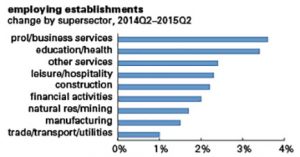
The most vibrant piece of the most recent QCEW report for Q2 2015 was the 2.8% over-the-year increase in the number of employing establishments. These are not necessarily startups, as they can be new locations of existing corporations, but it is nevertheless encouraging to see some action in this vital component of the job machine. As we often point out, young businesses generate a mighty share of gross job gains, even if they fail at an alarming rate as well. The failure rate, though, has a bright side in that it reallocates resources, which contributes to productivity. (As does job churn—when workers move between jobs they often carry innovative ideas with them.)

And new employing establishments are the ones who would really benefit from low rates on their loans, which they can still ink.This is, of course, only one quarter, which doth not a trend make. It would be great news if demand remains steady enough to give would-be entrepreneurs the confidence to build their businesses.

Here’s the super-sectoral breakdown:

EmpEst

by admin· · 0 comments · Employment & Productivity

About The Report

brujula

Managed by Philippa Dunne and Doug Henwood, TLR on the Economy is an independent research outfit located in New York.

Our proprietary surveys of state-level withholding and sales tax receipts are the backbone of our work. We have long-standing relationships with senior revenue estimators in tax departments around the country, whose insights give us a unique take on the state of the US economy. Instead of looking at total personal income receipts, which include non-wage income, we track withheld taxes since they are levied on wages and bonuses, not capital gains and the like.

We do our own macro-economic research, and, unlike many other research-providers, do not manage money: we are beholden to no one but our subscribers and ourselves.

Philippa Dunne and Douglas Henwood were John Liscio’s closest associates and, since John’s untimely death in 2000, are honored to be carrying on the research techniques he pioneered when he established The Liscio Report on the international scene in 1992.

We are known for our meticulous dissection of federal data, for pointing out technical anomalies glossed over in the mainstream press (and related debunking of market rumors), and for ferreting out market-moving shifts in the economic landscape as they develop, getting the news out to our readers before the mainstream media catches on. We also grill the highly informed senior tax officials who participate in our surveys on their favored indicators, like diesel-fuel consumption, and collect their thoughts on emerging economic trends for our subscribers. They are watching the cash flow into the state coffers so they know what they are talking about.

Look for us in Barron’s, the FT, Reuters, and the Wall Street Journal; on Bloomberg, Reuters, and CNBC; and around the web.

Philippa Dunne
Philippa Dunne was hired by John Liscio in 1996 to work on special projects, and in 1997 began full-time work as the “research department,” specifically to develop her own set of states for our monthly surveys of state tax collections and to handle the burgeoning demands of TLR on the Economy.

She graduated from University of California and has a Master’s Degree from Wesleyan University. A musician by training, in previous lives she has performed widely and taught at a number of colleges and private institutions, done research and writing for the Office of Ray and Charles Eames in California and for the American Museum of Natural History in New York, and, true to her name, worked in stables exercising steeplechasers. She lives in New York with her husband.

Douglas Henwood
While working toward his PhD in English at the University of Virginia, Doug returned to his earlier interest, the dismal science, and by the mid-1980s was regularly writing about the world economy with special attention to finance and the labor markets.

He caught the attention of John Liscio and as the “resident wise man” he crunched stats and analyzed them for John from the report’s very first days. A widely recognized economic analyst, Doug has given talks at venues all over the U.S. and abroad as well. He’s also frequently quoted or cited in the media, including newspapers ranging from The Asia Times to the New York Times to the Times of London.


Subscribe >


by admin· · 0 comments · TLR on the Economy

Our Track Record

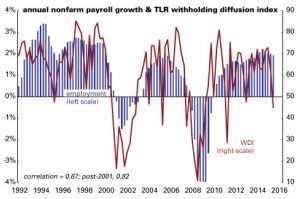
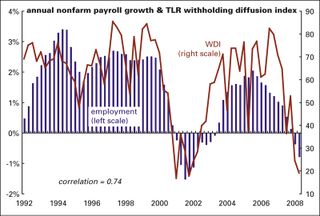
We’re the ones who track monthly withholding and sales tax receipts in the 25 largest states, and are known for our spot-on interpretation of what changes in revenue flows mean for our overall economy, and by traders around the world for the accurate forecasts of the BLS’s Employment Report, and the Census’s Advance Retail Sales print, both built on the results of our surveys. During  months when calendar effects influence revenue flows, like bonus season, we fine-tune our analysis to take such effects into account. But, as you can see below, even before we do that, state Withheld tax Diffusion Index has a .82 correlation with non-farm payrolls (both in year-over-year quarterly averages to smooth out noise). When our surveys start to change course, we are able to warn our readers that a change is coming before it surfaces in the official data:

WDI-&-E-yty-3-16

Our Sales Tax Diffusion Index (SDI) a .80 correlation with the Advance Retail Sales print:

SDI-&-retail-yty-3-16
The markets work on shocks to expectations: when our tax contacts are shocked, that’s something you need to know. And please note that both our WDI and our SDI picked up the current weakening trend early in the year.

Please read through our Sample Reports directly below to see our work, as it was published, for yourself. We’ve been warning our readers for decades about crucial trends before they were visible: the 2001 profit squeeze, hidden weakness in the labor market that led to several big downward benchmark revisions, research in 2006 showing that the then-current housing boom was an anomaly in US history, so preparing our readers for what was to come. We also flagged a sudden reversal in remittances to Mexico that signaled the housing collapse, and both recent collapses in oil prices. We pushed back on the idea that we were heading back into recession in 2012/13 because state-level withheld and sales receipts, while not great, were holding up. And, although it has been pretty monotonous, we began warning in 2009 that we were in for a decade-long slog through a swamp with chronic slow growth and inflation too low for the FOMC. For the last few years the FOMC, unfortunately, has been the only game in town, and we’ve providing steady, insightful analysis of what we knew they would do: work to overcome the stagnation that follows a financial crisis until there are real signs that wages are picking up, as they may, finally, be doing these days.

by admin· · 0 comments · TLR on the Economy