Articles by: admin

Longview: ECI

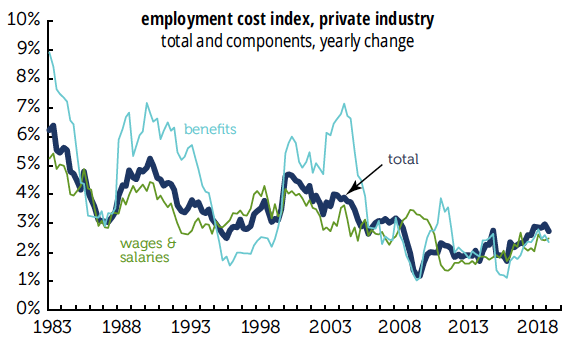
You might think a sub-4% unemployment rate would be nudging the employment cost index (ECI) higher, but it’s not.

In the first quarter, private sector compensation costs were 2.7% at an annual rate and were also up 2.7% for the year. That yearly gain was the lowest since the end of 2017. The softening was led by benefits, up 2.1% in the quarter and 2.4% for the year. Wage growth accelerated some, but still isn’t much above where it was at previous lows on the graph. And growth in overall compensation costs is also around the level of earlier lows. Wages remain the dog that didn’t bark.

by admin· · 0 comments · Employment & Productivity

NIPA review

There were some huzzahs over the first quarter GDP number. The 3.2% quarterly rate, while still below two of 2018’s quarters, was at the upper end of its recent range. And the yearly rate, also 3.2%, was the best in almost five years. But the quarter’s numbers do nothing to close the gap with the long-term trend, and the composition of growth was unimpressive.

As the graph below shows, actual GDP remains well below its 1970–2007 trendline, which is based on an average of 3.2% growth. Since 2019Q1 just matched that average, the trendline remained just as distant. GDP is now almost 17% lower than it would be had the 3.2% average prevailed after the Great Recession. That gap works out to a deficiency of almost $5,000 in per capita terms, which, given long-term relationships, works out to about $3,800 in after-tax personal income. Consumption is 16% below trend; nonresidential fixed investment, 15% below; residential investment, 40% below; and government, 20% below.

And important components of GDP sagged badly in the quarter.

Consumption contributed just 0.8 point to real GDP, less than half what it did the previous quarter, and well below the average for both this expansion and the average of all expansions between 1949 and 2007. The contribution of goods consumption was negative. Nonresidential investment was weak, with both equipment and structures contributing nothing, and only intellectual property making any contribution. Residential investment was a drag on growth. Imports were weak, which is actually a positive contribution to growth, since they’re counted as a subtraction from GDP, but it’s not a sign of strong domestic demand. Inventory investment—which was 0.6% of GDP in nominal terms, twice the average since 1980—contributed a hefty 0.7 point to the headline growth number.

But the headline number did look pretty decent.

by admin· · 0 comments · Employment & Productivity

Randall Forsyth’s IPO Roundup

Randy Forsyth posted a nice round-up of “high-wire” IPOs in Barron’s on Saturday, quoting some research we published last week:

“Wacky IPOs might be a sign that the long bull market is finally entering its blowoff phase (though these can take some time),” write TLR on the Economy’s Philippa Dunne and Doug Henwood. Though they admit they’re spoilsports, they point out that since 1980, IPOs have underperformed the broad market by over 18 percentage points, according to data from Jay Ritter of the University of Florida.

If you subscribe to Barron’s, read on….

https://www.barrons.com/articles/high-wire-ipos-like-pinterest-and-zoom-could-signal-a-market-top-51555711052

by admin· · 0 comments · TLR in the News

IPOs Underperforming the Broad Market

The unicorns are finally going public in size after a long delay. Lyft did its IPO at the end of March, and Uber will be coming any day now. And more as the year goes on, flooding the San Francisco Bay Area with billions, and separating techno-optimists from large quantities money. It’s almost like 1999 again, minus the productivity acceleration (and pervasive euphoria).

Perhaps we’re being spoilsports, but this is all looking rather frothy. We’ve been worrying for some time about stock market high valuations, but an exuberance has been missing. Wacky IPOs might be a sign that the long bull market is finally entering its blowoff phase (though these can take some time).

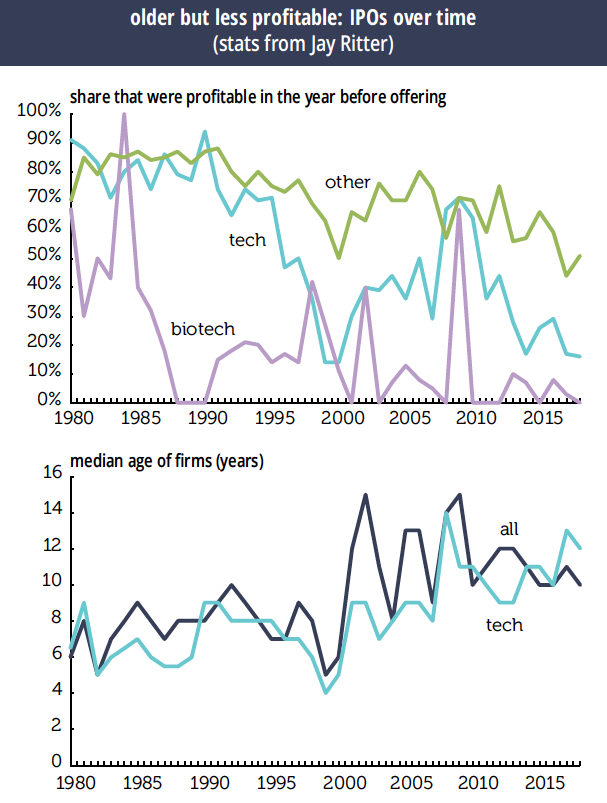
Here are some stats from the leading academic authority on IPOs, Jay Ritter of the University of Florida. As the top graph below shows, there’s been a long-term decline in the share of firms making their market debut that were profitable. In the 1980s, 81% of tech firms going public were profitable; that fell to 14% in 1999–2000 but rose back to 38% from 2001–2007 (though obviously many fewer floated stock in the early 2000s than the late 1990s). But we got back to 16% in 2018. The profitable share of firms classed as “other” has almost always been higher, but it follows a similar path. Biotech firms are the least profitable, but they’re often swinging for the fences with a single product rather than trying to build a broad business.

As the lower graph shows, today’s market debutantes are generally much older than those of the dot.com era—an average of twelve years in 2018 compared to less than eight at the end of the 1990s. Uber, which lost $3 billion on revenues of $11 billion last year, and which shows no signs of becoming profitable any time soon, is ten years old. (As the company confesses in its prospectus, “we may not be able to achieve or maintain profitability in the near term or at all.”) You might think a firm that’s not making money after a decade or more of life and survives only on constant infusions of cash from venture capitalists might not have the best prospects for the future. But, as conceded above, perhaps we’re being spoilsports.

But maybe not. Ritter shows that since 1980, using a three-year buy-and-hold strategy, IPOs have underperformed the broad market by over 18 percentage points. Which makes one want to ask a VC, if this firm is such a great investment, why are you selling it?

by admin· · 0 comments · Red Flags

Tracking the American Economy

Sightlines-image

At Sightlines Bulletin we:

Provide businesspeople and long-term investors with concise data-driven monthly analyses of the direction of the American economy so they can successfully formulate their business plans and fine-tune their resource allocations;

Use unique indicators that have proven successful at flagging turns in the economy to provide early warnings of shifts in the economic outlook;

Test and debunk commonly held misperceptions about current conditions, often employing the histories of crucial economic indicators we have compiled over the years, some back to the 1800s.

Sightlines Bulletin is published mid-month when the prior month’s important data points have been released. Each issue includes the results of our monthly surveys of state-level withheld and sales tax receipts (see Reference for more detail), our breakdown of important labor market and domestic consumption developments, a rundown of trends in fuel/electric usage and what they mean for coming months, comments on the direction of interest rates, and a two-page summary of important economic indicators, all in historical perspective.

For Sightlines Bulletin, we have developed proprietary data series based on monthly surveys of state revenue agencies and state fuel/ energy sales reports. These series provide the basis for the analysis of economic turning points and growth trends using diffusion indices, historical trend correlations, and forecasts. Analysis is done for the nation, regions, and states. In addition to guiding business planners and investors, including those who manage municipal debt portfolios, we believe the detail offered by these data series will help our clients create new jobs and better understand the advantages of returning jobs to the United States.

Additionally, each month we highlight a data series we follow, for example the Quit Rate or the Insured Unemployment Rate, so our readers become more fluent with our ongoing analysis and with the often ignored but rich data sources that offer our subscribers an edge over their competition.

Finally, we issue Special Bulletins as necessary to alert our subscribers to one-off developments like changes and biases in data collection methods, and other subtle but important signals missed by the mainstream media likely to affect employment, consumption, and interest rates.

Philippa and Doug have collected and analyzed state-level tax receipts since the early mid-1990s, and are widely respected for their ability to parse out the importance of trends in those revenue flows. Mike was, for many years, a state revenue contact in this work. His expertise in successfully developing off-beat indicators, like diesel fuel usage, spurred the development of Sightlines Bulletin.

We came together to provide a monthly forward-looking summary of current economic conditions, supported by our proprietary data, to fill a void in what is currently available to the business world. Financial professionals have long relied on the insights of The Liscio Report, a newsletter specifically tailored for traders. Sightlines Bulletin presents a broader perspective, based on these same insights and our combined experience, for decision-makers with a longer time frame.

 

Subscribe  >


by admin· · 0 comments · Sightlines Bulletin