
Inside Voices: Can’t Find Workers? Ask Jeff Korzenik to Help.
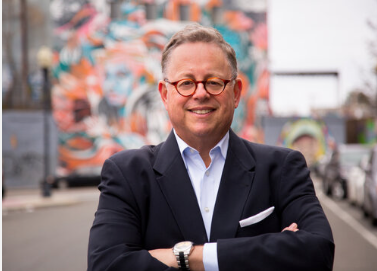
The unemployment rate is close to double what it was when we first learned of Jeff Korzenik’s work, but now, as then, employers carp about not being able to find workers. Jeff has a solution, and today we are fortunate to have roped him into an interview. Jeff is chief investment strategist at Fifth Third Bank in Chicago, and an expert and tireless advocate of getting those who have spent time behind bars into work-world.
Jeff’s book, Untapped Talent is now out, and highly recommended. An educated public is part of the re-entrance process, and we invite you to reach out to us or Jeff if you have questions or comments.
A practical man, Jeff opens his book with a note to those presently incarcerated, and if you donate books to your local prison, you might consider including a copy of his book in your next drop-off. (And, no, we don’t get a kick-back.)
Q. Thanks for taking the time to speak with us, Jeff. Let’s open with words. They matter. Second chancer, returning citizen, supervised persons, sometimes a refreshing ex-con. Could you say a few words about language & labels as they affect your work?
A. I agree with the premise that people-centered language is important. It is really wrong that someone with a felony conviction is termed a “felon” forever. I am, however, wary of using language in a scolding way as is sometimes done. It’s also worth noting that some of these terms don’t capture the entirety of the population that has been impacted by the criminal justice system – for example, only about half of the people convicted of felonies even had to serve an actual prison sentence, and people who have been arrested but found innocent can still face barriers. In the book I do have a section that touches very lightly on the language issue, and I most commonly use the broad phrase, “people with records.”
Q. I know a while back, while most of us weren’t exactly heading for the airport, you told me you were taking your first flight since lock-down so you could make a connection between a potential employee and employer, I think that’s it. That made me wonder what your days on the road are like.
A. In 2019 I did about 140 flight segments. The first pandemic-period flight I did was visiting with JBM Packaging, the company that’s the subject of the second-chance employer case study in the book. Although I could have done everything remotely, I felt I owed it to my readers to dive in as deeply as I could. I’ve been including that business for years in my talks and have worked with their visionary CEO many times, but I needed to get there in person. I now fly once or twice a month. The experience of flying has improved dramatically since my first trip, now that there’s very good adherence to mask protocols in airports and flying. Flying and travel is much less enjoyable during this period, with many amenities not open, the discomfort of masks on long plane rides, etc, but it has been doable.
Q. As long as I have followed your work you have taken the pragmatic approach, documenting that rejecting job applicants only because they have prison records makes no sense in a tightening labor market, and that employers who take on second chancers find they have loyal workers who are generally more productive than general hires.
That was when the unemployment rate was 3.5%. It’s close to twice that now, but that’s not a deal-breaker for your approach. Even with another 10 million unemployed persons, we’re hearing that employers are having trouble finding workers, before it was qualifications, now it’s UI benefits beating out what they are willing or able to pay.
It may be heartlessly practical to say that since it’s widely known that people with prison records for even minor offenses earn at least 10% less than those with similar skill sets and no records, but isn’t there a real opportunity here, especially with an influx of early releases to slow the spread of Covid in crowded prisons?
A. I emphasize in my work that this is business, not charity. People who have hit bottom and bounced back, often against extraordinary odds, display real character. The term most commonly associated with second chance hires is “grit.” If anything, the pandemic has highlighted the advantage of having a workforce of engaged and loyal employees. The challenge is that there is a right way to hire people with a criminal records and numerous wrong ways. The right way requires processes that identify who is ready to rebuild their lives, and provide the support systems needed. It is an investment – one with a very good payoff in low turnover expenses and productive employees, but an employer needs to understand the model that works. Support systems need not cost the employer anything, using government services, nonprofits or simply good internal mentoring, but the need for some level of accommodation is very real.
With unemployment still elevated, it is difficult to get companies to make any kind of investment, but those who had already established a talent pipeline from this population are sticking with it. We term the economic period of the pandemic as The Great Disruption, and this includes labor market disruptions with skill and geographic mismatches pointing to less abundance in available workers. For those industries hiring, there are already labor shortages. I’ve been contacted by two separate manufacturing companies in the last few weeks looking to explore second chance programs because they can’t find enough qualified traditional workers.
Q. I understand we need a national database for employers committed to hiring second chancers. Any word on how that’s going?
A. There are some initiatives that I know about but are not yet public, but I think the business community is about to assume a great leadership role in fixing this societal issue. Employment is foundational to rehabilitation, so this is something that simply cannot improve without business involvement. One of the challenges to this is that being a second chance employer is not always perceived as a positive by the public and consumers; businesses are wary of being identified as a company that hires people with a record, and that holds back corporate executives from even discussing the issue. I was trying to speak to an employer in Florida about his successful second chance hiring program, and his HR department convinced him not to meet with me.
Q. John Hopkins tracked 500 working parolees for three years and uncovered no “problematic terminations,” but there is also reluctance among some employers to hire those with prison records based on safety or liability concerns. The Society for Resource Management reports that eighty-two percent of managers said their ex-offender hires were at least as successful as their average hires, yet fourteen percent of managers say they would not hire an “ex-offender.”
We’re reading that many of the programs, like anger-management and high-school equivalency, designed to facilitate the transition from prison to work, are being cut in the pandemic.
Any thoughts on how employers themselves could put practices in place that would replace those programs In order to bring needed workers onboard?
A. Those program cuts are primarily due to health considerations, not budget, so this too shall pass. State prison authorities are increasingly working to build out these kinds of supportive programs, so I am actually quite hopeful. Again, though, this will work much better if employers see people behind bars as their future workforce and lobby for better in-prison programming. Many nonprofits have done a great job filling the void and some private sector employers have also shown exemplary leadership.
Q, Which facts do you find the best when helping potential employers get over their liability, and safety, fears?
A. I find it is often a matter of getting beyond the generalizations and helping employers think of people with records as individuals. In the book, I suggest that one way to do this is by using the technique of reductio ad absurdum: “So you’re saying every single person with a record cannot be a viable employee?” This shifts the conversation toward how you can make selections that avoid the risks. In terms of hard facts, I think it is very telling that fewer than half of the people with felony convictions were convicted of crimes of such threat to public safety that a prison term was required.
Q. Can you give some examples of how the private, public and not-for-profit sectors work together to bring returning citizens into the labor pool?
A. Sure – Michigan has a number of correctional facilities that include a Vocational Village, a training facility for residents that allow residents to earn industry-recognized credentials in carpentry, masonry, auto repair and other trades. DTE Corporation recently partners with the Michigan Department of Corrections to get one of these facilities to train for a specific need: tree trimmers. While jobs won’t be guaranteed, it creates a talent pipeline that addresses an important shortage for the company. The Atlanta Transit Authority changed a bus route to accommodate employers of second chance employer CKS Packaging.
Even more common are support programs offered by nonprofits. Nevada’s Hope for Prisoners offers 18 months of post-incarceration mentoring. Minnesota’s The Redemption Project starts employer mentoring six months before release from prison. Many nonprofits partner with employers to address housing or transportation needs.
Q. Many are taking the pandemic pause as an opportunity to rethink their own prejudices, and that gives us an opportunity to tie-in how underlying racism makes it especially hard for Black re-entrants to find a job. For example, Harvard political scientist Devah Pager* sent participants in her experiment out on job interviews, and found that whites with supposed felony records were more likely to get job offers than blacks without: black men with records had call-back rates of 5%, and 14% without records, but white men with records had rates of 17%, and 34% without. She also found that, when later audited, people who said they would have no trouble hiring someone with prison time were as unlikely to make the hire as those who fessed up they would have an issue. So much for self-knowledge. How have you experienced these prejudices in your work?
A. There are a lot of assumptions people make about people with records, and race can absolutely be a component of those prejudices. It is really important to recognize the tragic and ugly truth that the aftermath of our criminal justice system has left one in three Black men in America with a felony conviction. Despite all the pledges of diversity hiring, unless this is accompanied with a second chance initiative, our workforce will never reflect our population. I have a chapter on the book on the process of reentry, reframing the discussion to show that those who have exited incarceration and are viable job applicants have likely overcome a mountain of obstacles, and should be viewed as people of determination and accomplishment. I urge employers to focus on the individual’s journey, and that helps take away some of the inherent biases.
Q. And there’s always enlightened self-interest. McKinsey released work indicating that firms in the top broad diversity quartile as 35% more likely to have higher returns, and those in the bottom quartile statistically less so. Since black second-chancers are facing at least a double hurdle, if you were working with a potential employer, what are the questions you would encourage that person to ask him or herself before interviewing that potential employee?
A. One of the reasons we’ve had such little success is that employers often can’t ask the relevant personal questions, and even if they could, it’s really hard to make an assessment in the fairly short time of a hiring process when candidates have lived lives that are often very alien to the hiring manager. What works best is to create partnerships with people who do get to know and refer potential candidates. Often this is through reentry nonprofits. Sometimes through prison systems or probation/parole officers. A number of companies used temp staffing agencies that give employers a chance to make the assessment over time.
Q. Mount Sinai’s Coming Home Program, whose mission is to help people make the transition from prison or jail to their communities, intentionally hires counselors with records, with the expectation these employees will be open about the fact they have been in jail. Can you add some examples of jobs second chancers would be uniquely qualified to do?
A. There are so many people with records, that this is a talent pool with unlimited possibility, so I don’t like to pigeon hole people with records. I understand the benefits of the Mt. Sinai approach, but I actually think too many highly educated second chancers have no recourse but to find jobs in nonprofits, and need to have traditional private sector jobs. I flip the question and ask what industries would benefit from an employee with the lived experience of so many people. For example, I met the formerly-incarcerated principals of an ad agency in L.A., ConCreates, who argue – I think persuasively – that they can add a really useful perspective to any advertising or marketing campaign.
Q. Recent research on self-stigmatization among soon-to-be-released prisoners caused me to wonder how second-chancers characterize and refer to themselves. Can you relate your experiences listening to those who have been in prison speak of their lives as they exit the system?
A. I have a pretty nontraditional business book from the beginning. The very first section of the book is a two-page “A Note to the Currently Incarcerated” which acknowledges that people who are incarcerated feel a tremendous amount of guilt and feel they are a burden. My message to them is that they are a resource. This is obviously not the core audience for my book, but I thought it was important to write directly to them. Thanks to the generosity of Stephen Smith at Brandywine Investments, 500 of the books are being sent to prisons around the country. That’s actually a very tricky undertaking, but this project is working with Books Inside, an experienced nonprofit. One of the things I had to do to make this happen was work with HarperCollins to “demote” my book from a prestigious hardcover to a paperback since hardcovers typically aren’t allowed in correctional facilities.
Q. There are awesome stories about those took the plunge, even if there were stones in the path. For example, the owner of the cleaning facility who happened to see one of his employees wearing an ankle bracelet, the result of a bank robbery: “I was thinking I should fire him, and now he is one of my best friends.” Do you have a favorite story of your own?
A. My favorite story of witnessing this is the story of JBM Packaging, the subject of the Case Study chapter of my book. The company approached this from a purely business perspective but it has transformed the entire company in very positive ways. In my own life, I started this without knowing a single person who had a felony conviction. My work over that last seven years has formed real friendships with many formerly incarcerated people – they have truly enriched my life, and I am so grateful for their friendship.
Q. On the access to justice side, you’ve made the point that when someone has gone through our correctional system, s/he may then be locked out of that most basic necessity for life, and staying out of prison, a job.
I love how South Carolina AG Alan Wilson turned his prejudice into an evaluation of his own job success. As you know, but our readers may not, he discovered his best campaign volunteer worker had a felony record and, worrying about appearances, decided to fire him. But, apparently a logical man, he thought, “What kind of message would I be sending as the chief law enforcement officer of the state if I’m going to put a scarlet letter on your chest and relegate you to a lifetime prison sentence of being stereotyped and not employable?” Big topic, and maybe a side track, but we seem to have little confidence in the corrective effects of a system we put so much money into. Want to take that on?
A. I moderated a discussion with Republican AG Wilson and the Democrat AG of North Carolina, and both were completely committed to second chances, so constructive change is in the air. The system has been broken, but it is not irreparably broken. I’m actually very hopeful about the future. A big reason the system was broken was because neither the general public nor the business community were very engaged and that has changed.
Q. You may have seen that Erica Groshen, who used to head up the Bureau of Labor Statistics, and co-author Henry Holzer cited getting those with records back into the workforce high on their list of steps we can take to alleviate racial divides in economic status. So I’m just curious, not suggesting a change of plans about good business decisions in hiring practices—but with all the recent talk on inclusion, are words like justice and inclusion coming up more often?
A. Personally, I avoid a lot of those words. They can be too loaded with political viewpoints for me. My observation is that the local machine shop is much more likely to offer a real and supportive opportunity than many a more prestigious local cultural institution. A friend of mine ran an autobody shop in Miami – he looked up from his office one day to find that one of his former employees was back at work; the employee had exited the prison gates after a 5-year term and came directly to the job where he knew he would be welcomed. My friend and his wife would drive him to his Narcotics Anonymous meetings. People like this embrace a different terminology: “giving people a fair shake,” or “don’t judge a man until you’ve walked a mile in his shoes.” That’s the language I find drives real change, not the performative statements.
Q. Here’s an example of good economic sense close to my heart. You have pointed out the irony of our criminal system releasing prisoners into rehab while supporting policies that insure they will fail. Like, barbers who trained in prison and can’t get licenced.
I think I can top that. As you know, Inmate Fire Crews in California are filling a shortage of workers willing to take on that grueling job. But, even though they have learned the skill, and exhibited real heroism, felony convictions prevents them from getting an medical tech license, and they can’t the job. Kind of leaves you speechless.
I know there is talk about making it easily for inmate firefighters to make the transition, but that’s been going on and this is now. What’s your way out of this?
A. The firefighter issue in California was a travesty. I think that problem has finally changed as a result of public recognition, but there are so many of these. Complicating this is the fact that most of these restrictions are codified in state law, so the task is magnified 50-fold. I keep coming back to the fact that the answer has to lie with the business community’s involvement and that must include second-chance hiring. seve
Q, Can you please talk about or rank expunging records, which I think lifts wages and lowers recidivism, banning the box, other policy changes?
A. Expungement is very powerful because it removes the issue of stigma and of liability fears; the reform community tends to underestimate the role that negligent hiring liability fear play in deterring hiring. Reformers often point out that such lawsuits are very rare, to which I always respond, “I have fire insurance for my home.” There are other ways to reduce this barrier, either through direct legislation protecting employers or through ”certificates of rehabilitation,” typically available through petitioning a court. All these approaches should be easier to get – I’m not talking about compromising public safety, but easing the administrative burdens and costs, and yes, broadening their use where evidence suggests safety will not suffer.
There are whole other areas of reform that are very productive – ensuring that criminal justice system minimizes the disruptions to keeping someone employed. The elimination of cash bail is a good example – poverty has kept too many people in pre-trial detention. You still detain those who are a real risk, but too many people are in jail – and unable to go to their jobs — simply because they can’t post bail. Parole and probation should similarly be adjusted to focus mostly on those who are a risk to public safety.
Support for ban-the-box has become a quasi-religious belief for some in the justice community, but the evidence is weak that it does much good when dictated by government. My experience is that employers need a very conscious approach for second chance hiring to work, and ban-the-box does nothing to encourage that. For employers who have put such thoughtful hiring in place, it makes tremendous sense to voluntarily ban-the-box so as not to discourage applicants with records.
Q. If you aren’t in the position to hire anyone, what’s the best way to get involved? Please feel free to name organizations.
A. I get this question a lot, and frankly struggle with an effective answer. As consumers we can show that second chance hiring is a positive for companies by patronizing those that focus on second chance programs. I love the coffee I order from I Have a Bean Coffee (ihaveabean.com) and the bread from Dave’s Killer Bread, I try to buy some booze from Total Wine, and if I lived in Philadelphia, I’d go out of my way to get groceries from the stores owned by Brown’s Super Stores, but it is hard to know who’s doing what.
Some nonprofits in the reentry/workforce development space have volunteer roles, but people should only do this if they are willing to make a long-term commitment. Many of these nonprofits would benefit from financial support or business acumen on their board. If you work within a large company, I think just raising questions about the hiring, but you have to know what a real second chance program looks like. As citizens, I think we should be advocating for better policies and every municipality/government agency should have at least a second chance intern or apprenticeship program (hardly any do).
All of this works better when the public is educated. There are great podcasts out there – I’m a big fan of my friend Joshua Hoe’s Decarceration Nation Podcast (Decarceration Nation), which focuses heavily on policy. It’s embarrassingly self-serving, but I wrote my book with the thought that the chapters on policy, the demographics of justice-involvement, and the realities or the barriers to reentry, would all be a great place for the interested public to go, not just employers.
* Devah Pager’s early death is an incalculable loss.
Further reading:
Campaign volunteer with felony record:
Hiring Former Offenders as Economic Necessity
Ken Burns documentary on prison team outperforming Harvard in debate.
Education: Recidivism reduced by prison college programs
Diversity and enlightened self-interest




Recent work on income disparity
Setting the stage
UC Berkeley Economics Professor Emmanuel Saez recently updated his income-share spreadsheets through 2010, using data from the IRS’s Statistics of Income Division. This series includes capital gains, which results in more dramatic swings than one sees in series that exclude them.
Including capital gains real incomes fell 17.4% between 2007 and 2009, the largest decline since the Great Depression. Within that the incomes of the top 1% were down 36.3%, largely the result of the 74% decline in realized capital gains between 2007 and 2009, while those of the lower 99% were down 11.6%.
Painful for all, indeed, but skewed to the upper income groups, a trend that had more than retraced itself by the end of 2010, the most recent year of IRS data. Between 2009 and 2010 the incomes of the lower 99% rose only 0.2% while the incomes of the top percentile rose 11.6%, meaning that close to all the over-the-year improvement in income, when adjusted for population, was captured by that top percentile, 93% of it to be exact. (See links below for more data.)
That puts some numbers on why the recovery is experienced so differently by ordinary wage earners and by elite income groups, which in turn has surely heightened public awareness of our growing income disparity.
But there’s another big question out there. Whether you’re rooting for the upper or lower percentiles, if you spend a lot of time looking at income distribution tables, you can’t help but wonder why there is so little popular support for redistribution toward the middle classes, especially as the share of income going to the wealthiest citizens has risen toward levels last seen in the Roaring Twenties:
Piecing together what people think
In “The American Public Looks at the Rich,” sociologists David Weakliem and Robert Biggert round up a number of opinion polls on the subject taken over the last five decades and suggest some answers.
We’re re-quoting their opening quote because it’s a bit hard to remember that concerns about “tyranny of the majority” related to taxation have a long history. Back in late 19th Century England, as property restrictions on voting weakened, John Stuart Mill fretted, “…is it not a considerable danger lest [the majority] should throw…upon the larger incomes, an unfair share, or even the whole, of the burden of taxation; and having done so, add to the amount without scruple, expending the proceeds of modes supposed to conduce to the profit and advantage of the labouring class?”
Although American workers have fought for wages, unions, and benefits, why a push for inequitable tax burdens (some would say even equitable tax burdens) on the rich feared by Mill and his colleagues has never gained traction remains an open question. After reviewing polling evidence, Weakliem and Biggert note, “There is little support for direct redirection from the rich,” and, “Even the general principle of progressive taxation does not draw clear majority support.”
The paper is thoughtful, even-handed, and a refreshing break from dreary speculation that the lower-income groups are dominated by a disproportionate share of misguided lottery enthusiasts. The comments of the authors suggest a far more complex picture.
For one thing, the authors note that Americans are not opposed to higher taxes on the rich– 59% of respondents to a 2011 poll favored higher rates for families making at least $250K—but they don’t have much faith in the government’s ability to accomplish this. In one poll that inquired about the government’s ability to provide health care, college education, day care, and a few other services, “reducing the difference between the rich and poor” was the only item for which a larger percentage had had “no confidence at all,” rather than “a great deal of confidence.”
One pollster notes that since the 1980s “people have told pollsters that the rich, not themselves, will benefit from budget agreements. It does not seem to matter what the contents of the agreement are or whether they are negotiated by Republicans or Democrats.” Widespread belief that the rich get out of paying taxes leads respondents to believe that additional revenues intended to come from the wealthy would fall instead on the middle and lower incomes.
For another, poll respondents did not have an accurate idea of how big the current income gap is, and were in the dark concerning America’s international ranking in terms of economic equality. The authors found that although respondents were quite accurate in estimating compensation in a number of professions, they “dramatically underestimated” top executive incomes. For example, estimates of what CEOs and owners of large factories make were less than half the official estimates of actual salaries, as pieced together from a number of sources. Additionally, the margin between what respondents think executives make and what seems fair to them is considerably smaller than the margin between what respondents think executives make and what they actually make. (The authors note that respondents might have made more accurate estimates had they been asked about entertainers and athletes, rather than business-people, and that doctors’ and lawyers’ salaries are often over-estimated.)
In a 2006 poll, the respondents optimistically gave the US a mean ranking of 15th out of 32 industrialized nations in terms of economic equality as measured by income ratios. Our actual ranking was 28th, with only Mexico, Turkey, Hong Kong and Singapore more unequal.
And for yet another, across a number of polls, respondents showed strong agreement that the possibility of earning high salaries was important to the economy as a whole, and to bringing people into professions demanding a lot of preparation. One poll found 63% agreeing that the spending of millionaires gives "employment to a lot of people," with 23% not agreeing, and 68% agreeing that investments help "create jobs and provide prosperity," with 19% disagreeing. A majority agree that no one would go through law or medical school unless they could earn substantially higher incomes than ordinary workers. So concerns about the negative economic effects of curtailing income inequality look to be part of the explanation for the lack of support for redistribution.
On the other hand, the authors found little support for the idea that Americans over-estimate their own standing on the income ladder, and none at all for David Brooks's claims that 19% of Americans believe they are in the top percentile. In one older poll, 20% ranked their families as above or far above average, and 29% as below or far below average; in a newer poll 8% ranked themselves as poor, 19% as lower income, 11% as upper income, and 2% as rich. The halves don't add up, and are skewed to the lower side. The authors note the people tend to be generous in evaluating their abilities, so perhaps there is some over-estimation, but polling evidence suggests otherwise.
The common assumption that people over-estimate upward mobility is complicated by disparate estimations of what it means to be wealthy. One study found that those making $10K a year would require only $50K, while it would take $250K for those making around $75K, so definitions of “rich” probably include moving beyond a hand-to-mouth existence. But the authors suggest that respondents are generally quite reasonable in their expectations about becoming wealthy. Noting that 8% of households make more than $150K a year, and that one analysis of tax returns found a 50% turnover within the top 5% over ten years, the number of people who will be rich at some point is several times larger than the number who are rich at any given time. According to various polls, about 10% of respondents think it is very likely they will be rich, and about 24% that it’s somewhat likely, so they aren’t so far off.
In 2009, one set of pollsters concluded that, "Americans doggedly believe in the rags-to-riches story," but there's a problem with the question on which this conclusion is based: "Do you believe it is still possible to start out poor in this country, work hard, and become rich?" The authors point out that it's certainly possible, so the correct answer in fact is yes; people answering yes may well be acknowledging that possibility, not saying it's highly likely, just as the up to 40% who responded no were more likely commenting on the rareness of the event than the literal impossibility.
Some have suggested that the American public tends to idolize the rich, but this was not supported in polls. First, the majority of respondents indicated they don’t find the rich that interesting, although they like to read about celebrities. A majority of respondents to an AARP poll thought being wealthy was the result of hard work rather than luck, but other polls found that percentages of people who agreed and disagreed that people worked hard for their wealth, and agreed and disagreed that the wealthy had exploited people to get where they were, were about even. Weakleim and Biggert suggest that the number of people who dismiss luck’s importance in becoming wealthy might be unrealistically high because some people may understand “luck” to “mean completely haphazard events, rather than systematic factors such as being born in a wealthy family.”
Although a majority of respondents in one poll believe millionaires give generously to charities, 49% do not believe they feel a responsibility to society because of their wealth, 78% believe them more likely to be snobs, 66% less likely to be honest, and 54% think them more likely to be racists. So, although 61% think the very rich are more likely to be physically attractive, that hasn’t translated to general merit, so admiration for the rich does not rank high as a reason that Mill’s prediction has not come to pass.
And finally the authors take on happiness. Although polls have found that large majorities believe they would be happier if they made more money, and 60% would like to be rich, only about 40% believe they would be happier if they were rich. Fifty-two percent believe the rich are no happier than they are, with only 11% thinking the rich are happier, and 35%, less happy. The authors don’t really see a contradiction here. They note that people might prefer to be rich because it would provide better benefits for their children, or that they would like to be relatively better off than they are, but not necessarily rich. In any case, the authors suggest that people are “resisting the logical consequence of the principle that money makes life better.”
Who knew?
Notes:
Income distribution data available at Emmanuel Saez’s website: http://elsa.berkeley.edu/~saez/
If you would like to see a copy of, “America Looks at the Rich,” please get in touch with us.